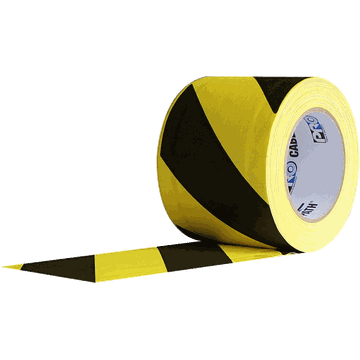
A cable across a walkway is the most common avoidable hazard on a live site. The right tape and a consistent method remove most of the risk.
Cables have to cross floors — from a desk to a stage, across a corridor, through a doorway. Taping them down badly creates two separate problems: people still trip on the ridge, and the tape has to be peeled off the cable jacket afterwards. Both are solved by the right product and a consistent method.
Zone-coated gaffer tape: adhesive along both edges, with a smooth non-adhesive centre tunnel. The cable sits in the tunnel and is held by the two adhesive edges — so the tape grips the floor, never the cable. Removal leaves the cable clean and the floor clean.
Taping directly over a cable sticks the adhesive to the jacket. On removal you either leave residue on the cable or peel it off in strips, and warm cables make it worse. It also creates a wider, more abrupt ridge, which is what people actually catch their feet on.
In a blackout, a taped cable run is invisible. Photoluminescent glow-in-the-dark tape absorbs energy from ambient light and glows in total darkness, rechargeable indefinitely and non-radioactive. Used to mark step edges, egress routes and the crossings themselves, it makes a route readable when the house lights are down. Charge it under normal lighting before the room goes dark.
See also: gaffer tape vs duct tape.

| Backing | Cotton cloth |
| Adhesive | Synthetic rubber, both edges |
| Tensile strength | 45 lbs/in |
| Elongation | 5% |
| Thickness | 11 mils |
| Adhesion to steel | 80 oz/in |
| Service temperature | 10°C–93°C (50°F–200°F) |
Non-adhesive tunnel width: 1.5 inch on the 3 inch roll, 2.5 inch on the 4 inch, 3.5 inch on the 6 inch. Match the tunnel to the cable bundle, not the other way round.
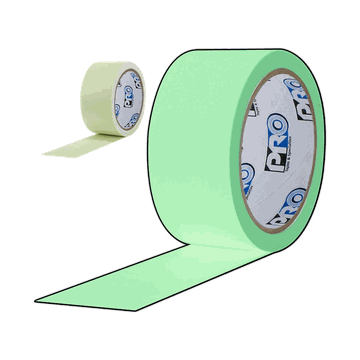
| Backing | Vinyl film |
| Thickness | 15 mils |
| Luminous compliance | PSPA Class B |
| Glow duration | Up to 10 hours per charge |
| Luminance | 68.2 mcd/m² at 10 min; 8.76 at 60 min |
| Peel adhesion (steel) | 96 oz/in at 15 min dwell |
| Light source | Non-radioactive |
Up to ten hours of glow per charge, recharged by any ambient light. PSPA Class B.
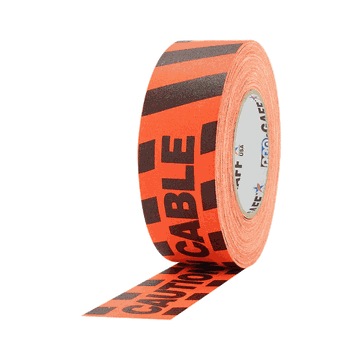
| Backing | Matte cotton cloth |
| Adhesive | Synthetic rubber |
| Tensile strength | 45 lbs/in |
| Elongation | 5% |
| Thickness | 11 mils |
| Adhesion to steel | 80 oz/in |
| Removal | Clean removability from wires |
Printed Pro Gaff — identical construction, high-visibility print.
Figures are Pro Tapes published technical data sheet values for products Artstag supplies. Typical values — not for use in writing specifications.
Cable path tape. It is zone-coated with adhesive on both edges and a non-adhesive centre tunnel, so it holds to the floor without sticking to the cable jacket. Ordinary gaffer tape applied over a cable will bond to the jacket and leave residue when removed.
For short crossings and controlled environments, properly applied cable path tape is the normal solution. For heavy public traffic, long runs, or wheelchair and trolley access, a physical cable ramp is more appropriate. Tape manages the trip edge; it does not carry rolling loads.
Clean the floor first, lay the cable with slack rather than under tension, press both edges down along the whole run, and reinforce doorways and corners with cross pieces. Most lifting traces back to dust or a cable pulling against the tape.
No. Photoluminescent tape absorbs energy from any ambient light and releases it in darkness. It recharges every time the lights are on, indefinitely, and contains no radioactive material.
Artstag supplies Pro Tapes products direct across Singapore, Malaysia and Indonesia. Tell us the surface, the environment and how long it needs to hold, and we will point you to the right product.